
WelkomNL Blog
Dutch Tax Return for Expats: A Step-by-Step Guide to Belastingaangifte (2026)
New to Dutch taxes? Learn how the three-box system works, how to file your 2026 tax return, key deductions, and important deadlines.
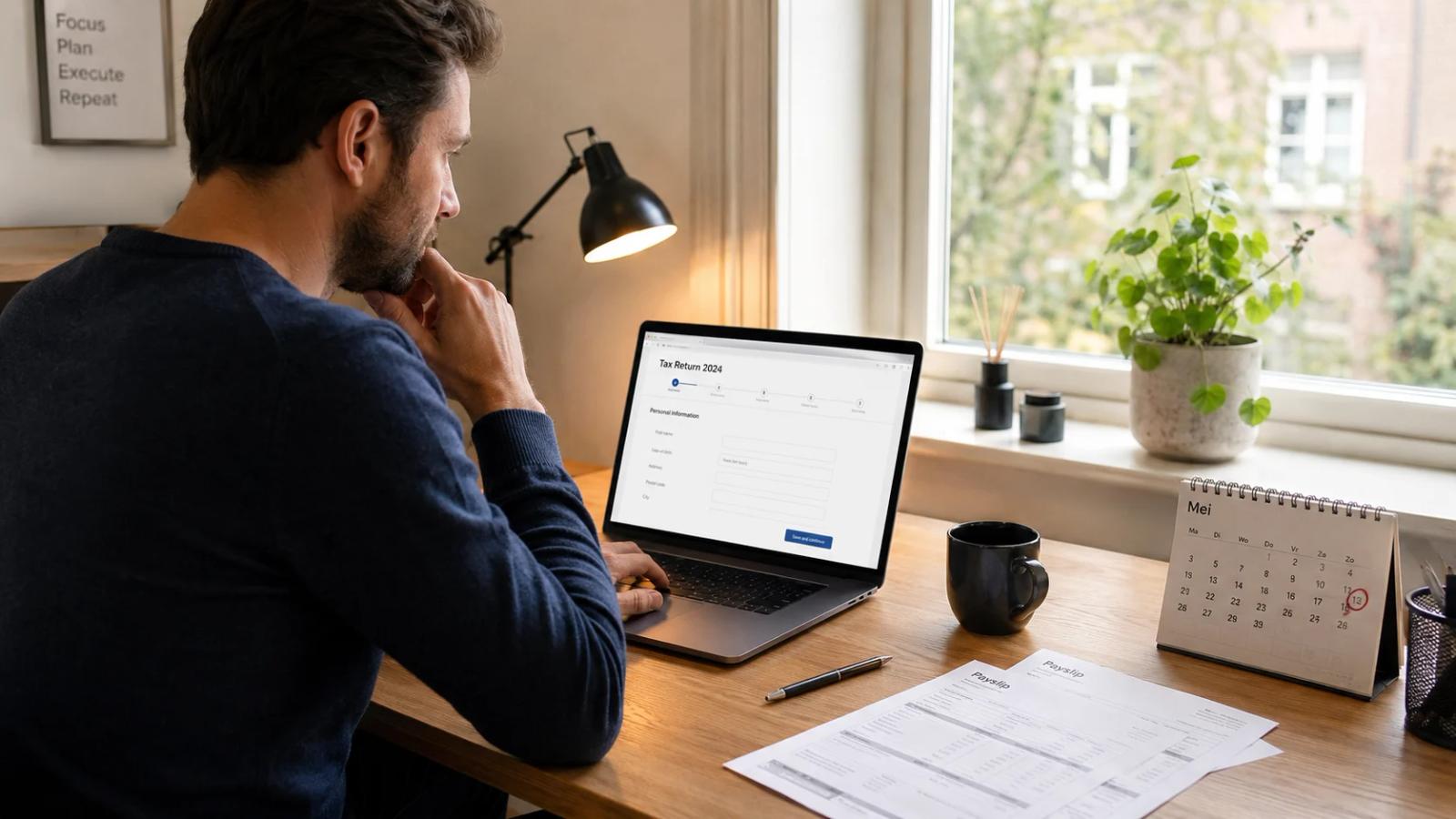
Every year between 1 March and 1 May, residents and workers in the Netherlands file their income tax return — the belastingaangifte. For many expats, the first time doing this feels bewildering: a new language, an unfamiliar tax code, and the nagging worry of getting something wrong.
The good news is that the Dutch system, while structured differently from most countries', is highly digitised and well-organised. For most employees, filing takes less than an hour online. This guide explains everything you need to know.
Do You Need to File?
Not everyone is required to file, but doing so is almost always in your interest. You must file a Dutch tax return if:
- You received an invitation letter (aanschrijving) from the Belastingdienst
- You earned income in the Netherlands that was not fully taxed at source
- You are claiming a tax refund or allowances
- You had income from multiple sources (employer, freelance work, foreign income)
Even if you are not required to file, many expats are entitled to refunds — for example, if they arrived partway through the tax year or if they over-paid provisional tax. Filing is almost always worth doing.
The Dutch Three-Box System
The Netherlands taxes income across three separate categories, called boxes:
Box 1: Work and Home Income
Box 1 is the most relevant box for most expats. It covers employment income, freelance earnings, benefits, pensions, and imputed rental income for homeowners (eigenwoningforfait). Tax rates in 2026 are 35.82% on income up to €75,518 and 49.5% on income above that threshold.
Box 2: Substantial Interest Income
Box 2 applies if you hold a substantial interest (at least 5%) in a Dutch or foreign company — for example, dividends or gains from selling shares in your own business. The rate in 2026 is 24.5% on income up to €67,804 and 31% on income above that.
Box 3: Savings and Investment Income
Box 3 taxes wealth — savings, investments, second properties, crypto, and foreign assets — above a threshold of approximately €57,000 per individual. Rather than taxing actual returns, the Dutch system calculates a deemed return and taxes that at 36%. The Dutch Box 3 system is currently being overhauled following a Supreme Court ruling and may change in your filing year — check the Belastingdienst website for the latest guidance.
The Filing Period and Deadline
The filing window opens on 1 March each year. The standard deadline for filing is 1 May, covering income from the previous calendar year.
If you need more time, you can request an extension from the Belastingdienst before 1 May. Extensions are generally granted automatically until 1 September. If you use a registered tax adviser (belastingadviseur), they can apply for a further extension on your behalf, sometimes pushing the deadline to the following April.
The P-Form vs the M-Form
P-Form (Particulier)
The P-form is the standard form for anyone who was a full-year Dutch tax resident. It is filed entirely online through the MijnBelastingdienst portal (mijn.belastingdienst.nl) using your DigiD. The portal pre-fills much of your data — income from your employer, bank account details, and known deductions — so you often only need to review and confirm.
M-Form (Migranten)
If you arrived in or departed from the Netherlands during the tax year, you must use the M-form (Migrantenformulier). This is a more complex paper-based form that covers your period of Dutch residency, your income during that period, and any foreign income you received before or after your Dutch residency. The M-form cannot be filed online through the standard portal; you request it from the Belastingdienst and submit it by post or via a tax adviser's system.
If it is your first year in the Netherlands, you almost certainly need the M-form. Consider hiring a tax adviser for this first filing — the cost is usually offset by the refund you receive.
How to File Online (P-Form)
- Log in to mijn.belastingdienst.nl using your DigiD.
- Select the tax year you are filing for and open your pre-filled return.
- Review your pre-filled income data. If your employer reported correctly, your Box 1 income will already be there.
- Add any additional income: freelance earnings, rental income, foreign income not taxed in the Netherlands.
- Add deductions: mortgage interest, study costs (if eligible), specific healthcare costs (if above threshold), alimony paid, and donations to registered charities.
- Check your Box 3 assets. Enter the value of your savings and investments as of 1 January of the tax year.
- Review the summary and submit. You will receive a confirmation. The expected refund or additional payment will be shown.
Common Deductions for Expats
Several deductions can reduce your taxable income or increase a refund:
- Hypotheekrenteaftrek — mortgage interest on your primary residence is deductible from Box 1 income
- Reiskosten — if your employer does not fully reimburse your travel costs, you may be able to deduct a portion
- Study costs — tuition and related expenses for professional development (being phased out but check current rules)
- Specific healthcare costs — out-of-pocket medical expenses above a statutory threshold
- Charitable donations — gifts to ANBI-registered Dutch charities above the threshold are deductible
The 30% Ruling and Your Tax Return
If you benefit from the 30% ruling, your employer already applies the untaxed allowance in your monthly payroll. You do not need to claim it separately in your tax return — it is pre-applied. However, as noted in a 2026 change, employees with the 30% ruling can no longer elect for partial foreign tax liability, meaning you will be taxed on your full Box 2 and Box 3 wealth for the year.
How Long Does a Refund Take?
If you file before 1 April, the Belastingdienst aims to process your return and pay any refund within three months. Returns filed later may take four to eight weeks after the deadline. In most cases, refunds are paid directly into the bank account registered with your BSN.
If you have a zorgtoeslag, huurtoeslag, or other advance allowances, reconcile them during the tax return process — over-estimated advances must be repaid, while under-estimates result in a payment to you.
Getting Help
If your tax situation is simple — one employer, no foreign income, no self-employment — the online portal is usually sufficient. If you have the 30% ruling, foreign assets, Box 2 income, or arrived mid-year, consider using a registered tax adviser (belastingadviseur). The Association of Dutch Tax Advisers (NOB) and organisations like Expatax, IQ EQ, and KPMG Meijburg have specialist expat tax practices.
Filing your belastingaangifte correctly in your first year sets you up well — many expats find they are owed a meaningful refund from the months before their 30% ruling was active or their deductions were fully applied.
WelkomNL: Tax Guidance for Newcomers
The WelkomNL app includes a plain-language guide to Dutch taxes for internationals, reminders about the 1 May deadline, and links to the Belastingdienst portal. Our multilingual AI assistant can explain how the Dutch tax system works in your language.
Next step
Put this guidance into action inside the WelkomNL app
Keep your momentum going with the WelkomNL app and move from reading advice to taking practical action in one place.
The app is built to help newcomers in the Netherlands navigate jobs, local systems, and day-to-day next steps with more clarity.
Continue reading
Related articles

Bringing or Buying a Car in the Netherlands: Registration and Tax Guide 2026
Understand how to register a car in the Netherlands in 2026, including RDW registration, BPM, road tax rates for petrol, hybrid and electric cars, and insurance.

Setting Up Utilities in the Netherlands: Energy, Water and Internet in 2026
Set up gas, electricity, water and internet in your new Dutch home. Compare fixed and variable energy contracts, meter readings, providers and moving-in timing for 2026.

Parental Leave and Child Benefits in the Netherlands: 2026 Guide for Families
Understand Dutch maternity, partner and parental leave rules for 2026, how UWV payments work, and how kinderbijslag child benefit is calculated and paid.